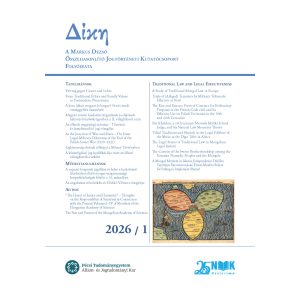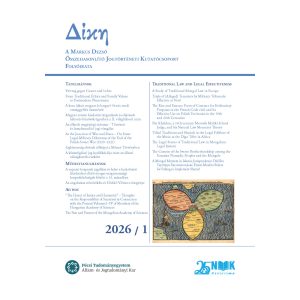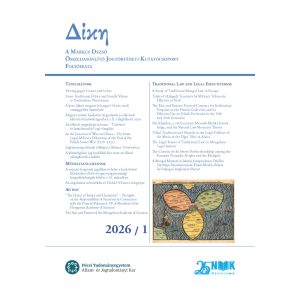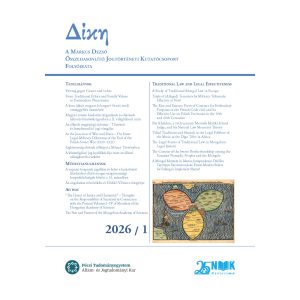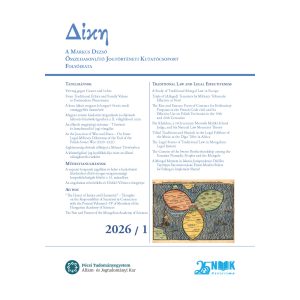
Szerző: Mészáros István László
Pécsi Tudományegyetem Állam- és Jogtudományi Kar 2026
Az eredeti nyelvű leírás hiányzik.
*****
The Antecedents of the Principle of Legal Certainty in the Mosaic Law
This study reveals that several elements of the principle of legal certainty already appear in an embryonic form in the ancient Mosaic Law. As such, the Law’s accessibility and availability to the people were ensured by the fact that it was publicly proclaimed and written down, and that its regular public readout and continuous teaching were required by law. Knowledge of the law was therefore not a secret science reserved for the few. The predictability of legal consequences – and, by virtue of this, the clarity of the law itself – was ensured by the fact that both the casuistic and general provisions of the law prescribed in advance the sanction for the violations they specified. Furthermore, the proclamation of the principle of talion made the severity of the sanction predictable. All of these factors reduced the possibility of arbitrary adjudication. Clarity of the norms was helped by the fact that the most important provisions were generally short, concise, often unconditional, and easy to memorize – a characteristic that applies, for example, to the Decalogue in its entirety. The Decalogue inscribed on the stone tablets also constitutes the immutable, universal moral foundation of the entire Law, which determines the framework and direction for the interpretation and application of all the Law’s specific provisions, thereby advancing legal uniformity and clarity of norms. It further expresses that laws cannot be regarded as mere acts of power. The Law prohibited any deviation from it, including any modification or override by the monarch himself. This ensured the stability and constancy of the law. Because of its declared nature as a covenant between the people of Israel and their God, the Law sets down in advance the benefits and obligations arising from the covenant. This implicitly included the exclusion of retroactive regulations at the level of human institutions. All of these – together with other elements, such as those promoting the primacy and supremacy of the law – had an undeniable influence on legal thought within the Judeo-Christian cultural sphere and, indirectly, on the development of the modern concept of the rule of law.
A részletes adatlapot a képre vagy a címre kattintva érheti el.
Ingyenesen letölthető, open access kiadvány
| Elolvasom (pdf) | Letöltöm (pdf) |
Open access kiadvány
Gyorsnézet
Kedvencekhez