


Open access kiadvány
Kedvencekhez
Szerző: Surjányi Dávid
Pécsi Tudományegyetem Állam- és Jogtudományi Kar 2026
A cikk angol nyelvű.
*****
Many Islamic fundamentalists today retrace their ‘law of war’ back to a medieval jurist called Ibn Taymiyya. One of the most controversial elements in the mufti’s legacy was when he issued the so-called Mardin fatwa against the Mongol leaders of the Ilkhanate. Ibn Taymiyya declares these leaders kafir (act of takfir) for not implementing Sharia law in the Ilkhanate despite their conversion to Sunni Islam. The question of this paper is whether this fatwa means that Ibn Taymiyya advocated for rebellion against wayward Muslim leaders or not. This paper does what only a few works on Ibn Taymiyya ventured so far: not only to shed light on the historical context in which the legal instrument of the Mardin fatwa was issued but also to concurrently elaborate on Ibn Taymiyya’s stance on Muslim authority. Thus, the research establishes that taking into account his other works as well, it is clear that the mufti did not wish to initiate an internal jihad against Muslim leaders, as he did not even regard the Ilkhans as Muslims. Therefore, what he did is to call for the basic form of military jihad against unbelievers. While vast research concentrates on the mufti’s longstanding influence on fundamentalists, our present comparative analysis also examines how the Mardin fatwa has been invoked by modern Islamists and jihadists to justify violent actions against their national leaders, based on a particular interpretation of Sharia derived from a medieval jurist whose formulation was sufficiently ambiguous to arguably permit such usage. Ideally, this contributes to the library worth of research regarding the mufti inasmuch as it sheds new light on the real impact Ibn Taymiyya has had on the development of Islamic law of war (Fiqh al-Jihad).
.
A részletes adatlapot a képre vagy a címre kattintva érheti el.
Ingyenesen letölthető, open access kiadvány
| Elolvasom (pdf) | Letöltöm (pdf) |
Részletek
A kiadvány adatai
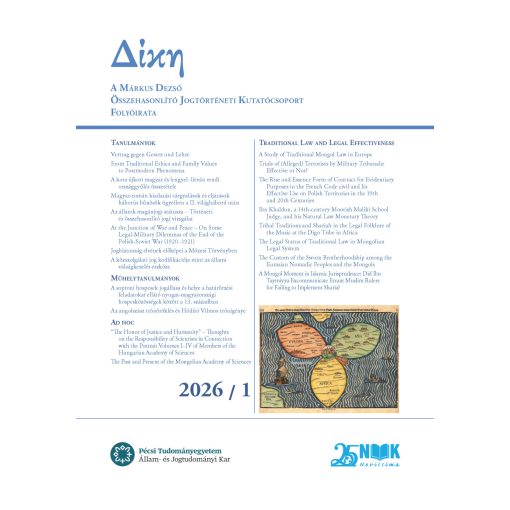
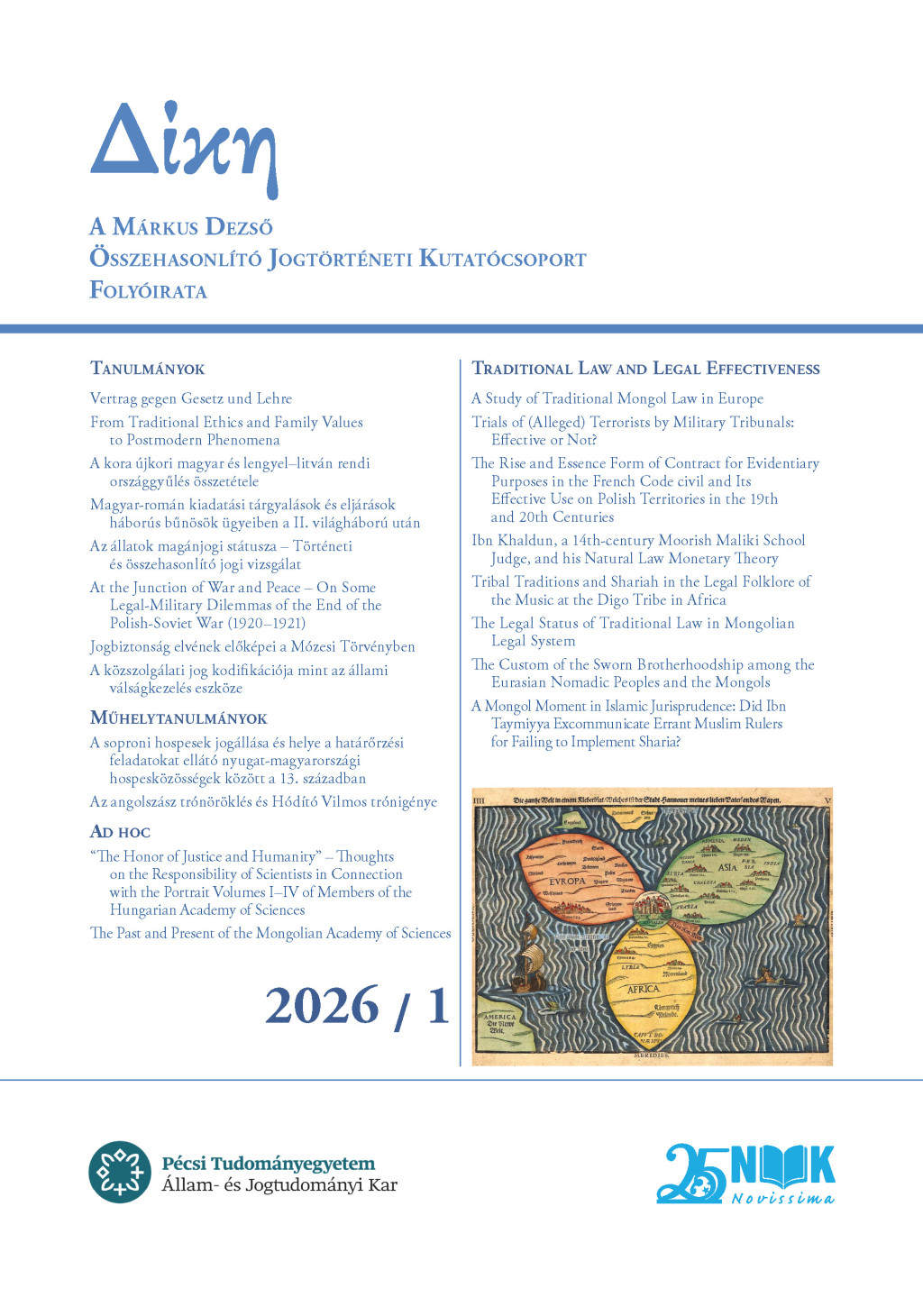
Cím (Eredeti nyelven): A Mongol Moment in Islamic Jurisprudence: Did Ibn Taymiyya Excommunicate Errant Muslim Rulers for Failing to Implement Sharia?
Cím (Angolul): A Mongol Moment in Islamic Jurisprudence: Did Ibn Taymiyya Excommunicate Errant Muslim Rulers for Failing to Implement Sharia?
Sorozat (Eredeti nyelven): DIKÉ 2026/1
Sorozat (Angolul): DIKÉ 2026/1
Kapcsolódó tartalmak (a könyvhöz kacsolódó online tartalmak linkjei, előadás, stb…):
Szerző(k): Surjányi Dávid ORCID ID: 0009-0008-7717-7388.
Szerkesztő(k): Herger Cs. Eszter – Schweitzer Gábor (2017–2026)
Lektor(ok):
Közreműködő(k):
Szerkesztőbizottság:
Antal Tamás (Szeged) – Barna Attila (Győr) – Béli Gábor (Pécs) – Dziadzio, Andrzej (Krakkó) – Falus Orsolya (Dunaújváros) – Halász Iván (Budapest/Pozsony) – Holcman, Borut (Maribor) – Képes György (Budapest) – Korsósné Delacasse Krisztina (Pécs) – Krešić, Mirela (Zágráb) – Lehotay Veronika (Miskolc) – Memišević, Ehlimana (Szarajevo) – Nguyen Thi My, Linh (Can Tho) – Schumann, Eva (Göttingen) – Szabó Béla (Debrecen) – Szabó István (Budapest) – Szente Zoltán (Budapest) – Steppan, Markus (Graz) – Stipta István (Budapest) – Tauchen, Jaromír (Brünn)
Olvasószerkesztő:
Niklai Dominika Patrícia
(szerzőknél és közreműködőknél is ORCID és Webcím, ha van):
Nyelv(ek): angol
Leírás (Eredeti nyelven): Many Islamic fundamentalists today retrace their ‘law of war’ back to a medieval jurist called Ibn Taymiyya. One of the most controversial elements in the mufti’s legacy was when he issued the so-called Mardin fatwa against the Mongol leaders of the Ilkhanate. Ibn Taymiyya declares these leaders kafir (act of takfir) for not implementing Sharia law in the Ilkhanate despite their conversion to Sunni Islam. The question of this paper is whether this fatwa means that Ibn Taymiyya advocated for rebellion against wayward Muslim leaders or not. This paper does what only a few works on Ibn Taymiyya ventured so far: not only to shed light on the historical context in which the legal instrument of the Mardin fatwa was issued but also to concurrently elaborate on Ibn Taymiyya’s stance on Muslim authority. Thus, the research establishes that taking into account his other works as well, it is clear that the mufti did not wish to initiate an internal jihad against Muslim leaders, as he did not even regard the Ilkhans as Muslims. Therefore, what he did is to call for the basic form of military jihad against unbelievers. While vast research concentrates on the mufti’s longstanding influence on fundamentalists, our present comparative analysis also examines how the Mardin fatwa has been invoked by modern Islamists and jihadists to justify violent actions against their national leaders, based on a particular interpretation of Sharia derived from a medieval jurist whose formulation was sufficiently ambiguous to arguably permit such usage. Ideally, this contributes to the library worth of research regarding the mufti inasmuch as it sheds new light on the real impact Ibn Taymiyya has had on the development of Islamic law of war (Fiqh al-Jihad).
Leírás (Angol): Many Islamic fundamentalists today retrace their ‘law of war’ back to a medieval jurist called Ibn Taymiyya. One of the most controversial elements in the mufti’s legacy was when he issued the so-called Mardin fatwa against the Mongol leaders of the Ilkhanate. Ibn Taymiyya declares these leaders kafir (act of takfir) for not implementing Sharia law in the Ilkhanate despite their conversion to Sunni Islam. The question of this paper is whether this fatwa means that Ibn Taymiyya advocated for rebellion against wayward Muslim leaders or not. This paper does what only a few works on Ibn Taymiyya ventured so far: not only to shed light on the historical context in which the legal instrument of the Mardin fatwa was issued but also to concurrently elaborate on Ibn Taymiyya’s stance on Muslim authority. Thus, the research establishes that taking into account his other works as well, it is clear that the mufti did not wish to initiate an internal jihad against Muslim leaders, as he did not even regard the Ilkhans as Muslims. Therefore, what he did is to call for the basic form of military jihad against unbelievers. While vast research concentrates on the mufti’s longstanding influence on fundamentalists, our present comparative analysis also examines how the Mardin fatwa has been invoked by modern Islamists and jihadists to justify violent actions against their national leaders, based on a particular interpretation of Sharia derived from a medieval jurist whose formulation was sufficiently ambiguous to arguably permit such usage. Ideally, this contributes to the library worth of research regarding the mufti inasmuch as it sheds new light on the real impact Ibn Taymiyya has had on the development of Islamic law of war (Fiqh al-Jihad).
Kulcsszavak (eredeti nyelven és angolul is): Islamic legal theory, law of war, jihad, takfir, excommunication, Ibn Taymiyya, Sharia, Islamic state, fundamentalism
Tudományos besorolás (eredeti nyelven és angolul is): Tanulmány, paper
Tudományterület (eredeti nyelven és angolul is): Jog, law
Támogatók:
Kiadó: Pécsi Tudományegyetem Állam- és Jogtudományi Kar
Társkiadó: Novissima Kiadó Bt.
Megjelenés éve: 2026
Megjelenés helye (város, eredeti nyelven): Budapest
Megjelenés helye (ország, eredeti nyelven, angolul): Magyarország, Hungary
Formátum: Pdf, epub
DOI: 10.15170/DIKE.2026.10.01.16
Oldalszám: 219-234
ISBN:
ISSN: 2631-1232
Nyomtatott verzió:
Kiadás: 2026
Jogok: Creative Commons CC BY
A kiadvány linkje:
Hivatkozások a könyvben
References in the book
Al-Azami, Usaama: ‘Abdullāh Bin Bayyah and the Arab Revolutions: Counter-Revolutionary Neo‐Traditionalism’s Ideological Struggle against Islamism. Muslim World 109:3, 2019, 343–361,
Al-Qaradawi, Yusuf: Islamic Awakening Between Rejection and Extremism. London 2006
Al-Qaradawi, Yusuf: Priorities of The Islamic Movement in the Coming Phase. Cairo 1992
Almond, Gabriel A. – Appleby, R. Scott – Sivan, Emmanuel: Strong Religion – The Rise of Fundamentalisms around the World. Chicago 2003
Benjamin, Daniel – Simon, Steven: The Age of Sacred Terror – Radical Islam’s War Against America. New York 2002 (iBook edition)
Catherwood, Christopher: A Brief History of the Middle East – From Abraham to Arafat. New York 2006
Euben, Roxanne L. – Zaman, Muhammad Qasim: Princeton Readings in Islamist Thought – Texts and Contexts from al-Banna to Bin Laden. Princeton NJ 2010
Faraj, Muhammad ‘Abd al-Salam (as ‘Abdus Salam Faraj): The Absent Obligation. Birmingham 2000
Gerges, Fawaz A.: ISIS: A history. Princeton NJ 2017
Hoover, Jon: Makers of the Muslim World – Ibn Taymiyya. London 2019
Humphreys, R. Stephen: Islamic History: A Framework for Inquiry – Rev. Ed. Princeton NJ 2020
Ibn Taymiyya – Farruk, Omar A. (transl.): Siyāsah al-sharʻīyah fī iṣlāḥ al-rāʻī wa-al-raʻīyah (Ibn Taymiyya on Public Law and Private Law in Islam or Public Policy in Islamic Jurisprudence). Beirut 1966
Islam, Jaan S. – Eryiğit, Adem: Islam and the State in Ibn Taymiyya – Translation and Analysis. New York 2022
Jansen, Johannes J. G.: Faraj, Muhammad ‘Abd al- Salam (1954-82). In: Bowering, Gerhard (ed.): Princeton Encyclopedia of Islamic Political Thought. Princeton NJ 2013
Jansen, Johannes: The Dual Nature of Islamic Fundamentalism. Ithaca NY 1997
Laoust, Henri: La profession de foi d’Ibn Taymiyya. Paris 1986
Laoust, Henri Le Traité de droit public d'Ibn Taimîya (édition et traduction). Damascus 1952
Lewis, Bernard: The Political Language of Islam. London 1988
Maher, Shiraz: Salafi-Jihadism – The History of An Idea. Oxford 2016
Michot, Yahya M.: Ibn Taymiyya. In: Bowering, Gerhard (ed.): Princeton Encyclopedia of Islamic Political Thought. Princeton NJ 2013
Rapoport, Yossef – Ahmed, Shahab: Ibn Taymiyya and His Times. Karachi 2010
Sheikh, Naveed S.: Making Sense of Salafism – Theological Foundations, Ideological Iterations, and Political Manifestations. In: Haynes, Jeffrey (ed.): The Routledge Handbook on Religion, Politics and Ideology. New York 2022
Simon Róbert: Az iszlám fundamentalizmus – Gyökerek és elágazások Mohamedtől az al-Qá’idáig [Islamic Fundamentalism – Roots and Ramifications from Muhammad to al-Qa’ida]. Budapest 2014
Sivan, Emmanuel: Radical Islam – Medieval Theology and Modern Politics. New Haven CT 1985
Zaman, Muhammad Qasim: Modern Islamic Thought in a Radical Age – Religious Authority and Internal Criticism. New York 2012
Adatok
Szerző(k), szerkesztő(k)
Surjányi Dávid
Kiadó
Pécsi Tudományegyetem Állam- és Jogtudományi Kar, Novissima Kiadó
Tudományterület
jog, law
Kulcsszavak
Islamic legal theory, law of war, jihad, takfir, excommunication, Ibn Taymiyya, Sharia, Islamic state, fundamentalism
Sorozat
DIKÉ
Nyelv
angol
Cikkszám
DIKE20260116