


Open access kiadvány
Kedvencekhez
Szerző: Kanyar Adrienn
Pécsi Tudományegyetem Állam- és Jogtudományi Kar 2026
A cikk angol nyelvű.
*****
The East African Digo tribe is a young Islamic group, just a hundred years old. In addition to their unique, folk Islamic religion, they have strong tribal traditions and customs, which can be felt in all areas of their society. This duality also appears in areas of regulations in culture and music. By studying them, on the one hand, we can help preserve these special legal customs, and on the other hand, they can help us to understand how Shariah functions in young Muslim groups.
A részletes adatlapot a képre vagy a címre kattintva érheti el.
Ingyenesen letölthető, open access kiadvány
| Elolvasom (pdf) | Letöltöm (pdf) |
Részletek
A kiadvány adatai
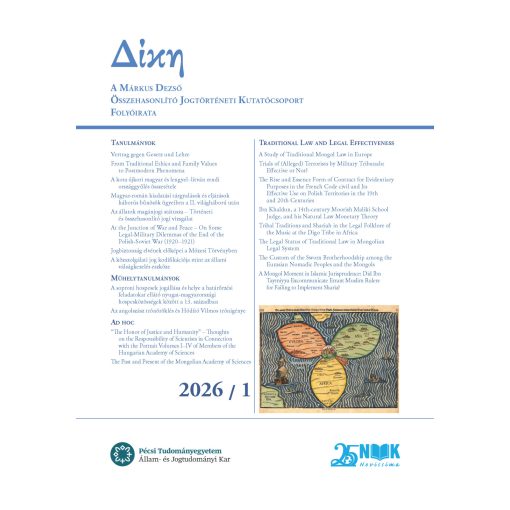
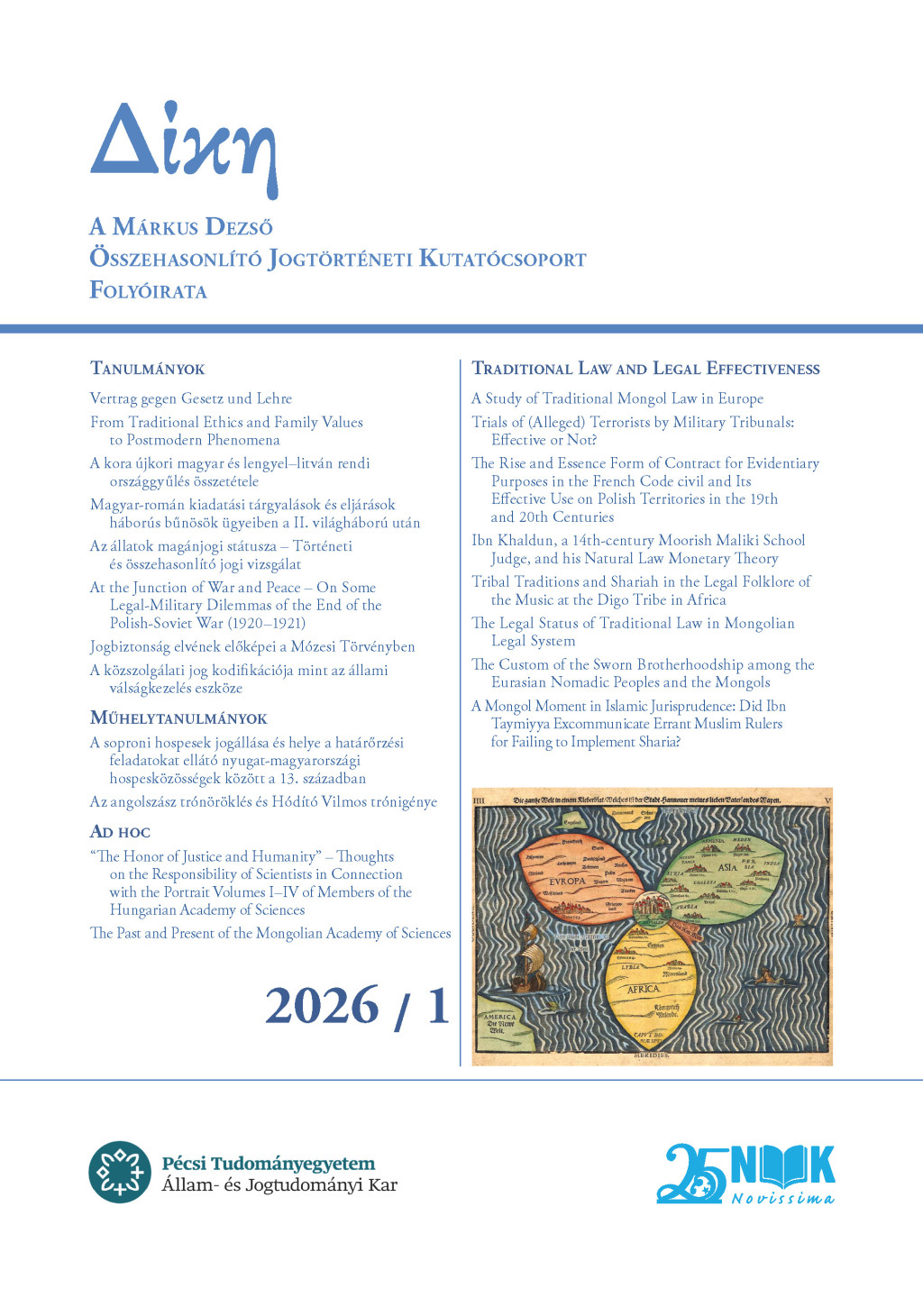
Cím (Eredeti nyelven): Tribal Traditions and Shariah in the Legal Folklore of the Music at the Digo Tribe in Africa
Cím (Angolul): Tribal Traditions and Shariah in the Legal Folklore of the Music at the Digo Tribe in Africa
Sorozat (Eredeti nyelven): DIKÉ 2026/1
Sorozat (Angolul): DIKÉ 2026/1
Kapcsolódó tartalmak (a könyvhöz kacsolódó online tartalmak linkjei, előadás, stb…):
Szerző(k): Kanyar Adrienn ORCID ID: 0009-0005-0655-7349.
Szerkesztő(k): Herger Cs. Eszter – Schweitzer Gábor (2017–2026)
Lektor(ok):
Közreműködő(k):
Szerkesztőbizottság:
Antal Tamás (Szeged) – Barna Attila (Győr) – Béli Gábor (Pécs) – Dziadzio, Andrzej (Krakkó) – Falus Orsolya (Dunaújváros) – Halász Iván (Budapest/Pozsony) – Holcman, Borut (Maribor) – Képes György (Budapest) – Korsósné Delacasse Krisztina (Pécs) – Krešić, Mirela (Zágráb) – Lehotay Veronika (Miskolc) – Memišević, Ehlimana (Szarajevo) – Nguyen Thi My, Linh (Can Tho) – Schumann, Eva (Göttingen) – Szabó Béla (Debrecen) – Szabó István (Budapest) – Szente Zoltán (Budapest) – Steppan, Markus (Graz) – Stipta István (Budapest) – Tauchen, Jaromír (Brünn)
Olvasószerkesztő:
Niklai Dominika Patrícia
(szerzőknél és közreműködőknél is ORCID és Webcím, ha van):
Nyelv(ek): angol
Leírás (Eredeti nyelven): The East African Digo tribe is a young Islamic group, just a hundred years old. In addition to their unique, folk Islamic religion, they have strong tribal traditions and customs, which can be felt in all areas of their society. This duality also appears in areas of regulations in culture and music. By studying them, on the one hand, we can help preserve these special legal customs, and on the other hand, they can help us to understand how Shariah functions in young Muslim groups.
Leírás (Angol): The East African Digo tribe is a young Islamic group, just a hundred years old. In addition to their unique, folk Islamic religion, they have strong tribal traditions and customs, which can be felt in all areas of their society. This duality also appears in areas of regulations in culture and music. By studying them, on the one hand, we can help preserve these special legal customs, and on the other hand, they can help us to understand how Shariah functions in young Muslim groups.
Kulcsszavak (eredeti nyelven és angolul is): folk Islam, Legal customs, Shariah, music, Digo tribe
Tudományos besorolás (eredeti nyelven és angolul is): Tanulmány, paper
Tudományterület (eredeti nyelven és angolul is): Jog, law
Támogatók:
Kiadó: Pécsi Tudományegyetem Állam- és Jogtudományi Kar
Társkiadó: Novissima Kiadó Bt.
Megjelenés éve: 2026
Megjelenés helye (város, eredeti nyelven): Budapest
Megjelenés helye (ország, eredeti nyelven, angolul): Magyarország, Hungary
Formátum: Pdf, epub
DOI: 10.15170/DIKE.2026.10.01.13
Oldalszám: 173-186
ISBN:
ISSN: 2631-1232
Nyomtatott verzió:
Kiadás: 2026
Jogok: Creative Commons CC BY
A kiadvány linkje:
Hivatkozások a könyvben
References in the book
Cooper, Frederick: Colonial History. Leiden 2010, https://www.ascleiden.nl/kenya-coast/reviews/cooper/colonial-history (01. 10. 2024)
Digo. Africa 101 Last Tribes, https://www.101lasttribes.com/tribes/digo.html (16. 09. 2024)
Digo Language and Literacy Project, https://chidigo.com/en/mother-tongue-education-program-digo (16. 09. 2024)
Digo of Tanzania and Kenya. Pray Africa, https://prayafrica.org/project/digo-kenya-tanzania/ (16. 09. 2024)
Falus, Orsolya: The Legal Institutions of Charity in the Traditional Islamic Law. Sarajevo 2020
Falus, Orsolya: A jótékonyság és a közösségi gondoskodás jogintézményei a Shariában Legal Institutions of Charity and Community Care in Sharia. Polomia 2022
Hedin, Christer: Muslim pilgrimage as education by experience. Scripta Instituti Donneriani Aboensis No. 22/2010, 163–195, https://journal.fi/scripta/article/view/67366 (08. 10. 2024)
Hillenbrand, Carole: Az iszlám – Új történeti bevezetés [Islam. A New Historical Introduction by Carol Hillenbrand]. Budapest 2016
Hrbek, Ivan: Ibn Battuta. Encyclopaedia Britannica, https://www.britannica.com/biography/Ibn-Battuta (03. 10. 2024)
Islam Ist: Dürfen Muslime Musik hören?, https://islam-ist.de/duerfen-muslime-musik-hoeren/ (25. 11. 2022)
Jany János: Klasszikus iszlám jog – Egy jogi kultúra természetrajza [Classical Islamic Law – The History of a Legal Culture]. Budapest 2021
Kárpáti János: Kelet zenéje [Music of the East]. Budapest 1981
Korán – Hungarian version (transl. Simon Róbert). Budapest 1987
Mukhwana, Mohammed Amedo – Awadh, Ali Hemed – Chidongo, Munga Tsave Wa: Islamic Cultural Heritage at the Coast of Kenya: Focus on the Digo Community of Mtongwe. International Journal of Social Science Humanity & Management Research No. 2/2023, 155–164.
Neubauer, Eckhard: Islamic religious music, https://www.oxfordmusiconline.com/grovemusic/display/10.1093/gmo/9781561592630.001.0 001/omo-9781561592630-e-0000052787?rskey=UnQzOt&result=4 (21. 02. 2023)
Ruqyah, A Remedy for Illnesses, Evil Eye, Magic and Jinn from the Qur’an and Sunnah, https://uwt.org/wp-content/uploads/2019/03/Ruqyah-Booklet.pdf (24. 09. 2024)
Shaikh Muhammad Salih Al-Munajjid: Der Islam – Frage und Antwort, https://islamqa.info/ge/answers/5000/das-urteil-uber-die-musik-den-gesang-und-das-tanzen (25. 11. 2022)
Sperling, David Colton: The growth of Islam among the Mijikenda of the Kenya coast, 1826–1933. Doctoral thesis. School of Oriental and African Studies University of London. London 1988
The Kaya Kinondo Forest Conservation Group, https://kayakinondo.com/ (16. 09. 2024)
Wallace, Sarah (ed.): The Digo Mission of the Anglican Church of Kenya: Essays in Commemoration of 114 Years of Mission Work in
Kwale County (1904-2018). Wilmore, Kentucky 2020, https://place.asburyseminary.edu/academicbooks/34/ (23. 09. 2024)
Wright, Owen – Poché, Christian – Shiloah, Amnon: Arab music, https://www.oxfordmusiconline.com/grovemusic/display/10.1093/gmo/9781561592630.001.0 001/omo-9781561592630-e-0000001139?rskey=UnQzOt (27. 02. 2023)
2019 Kenya Population and Housing Census. Volume 4: Distribution of Population by Socio-Economic Characteristics, https://www.knbs.or.ke/reports/kenya-census-2019/ (16. 09. 2024)
Adatok
Szerző(k), szerkesztő(k)
Kanyar Adrienn
Kiadó
Pécsi Tudományegyetem Állam- és Jogtudományi Kar, Novissima Kiadó
Tudományterület
jog, law
Kulcsszavak
folk Islam, Legal customs, Shariah, music, Digo tribe
Sorozat
DIKÉ
Nyelv
angol
Cikkszám
DIKE20260113